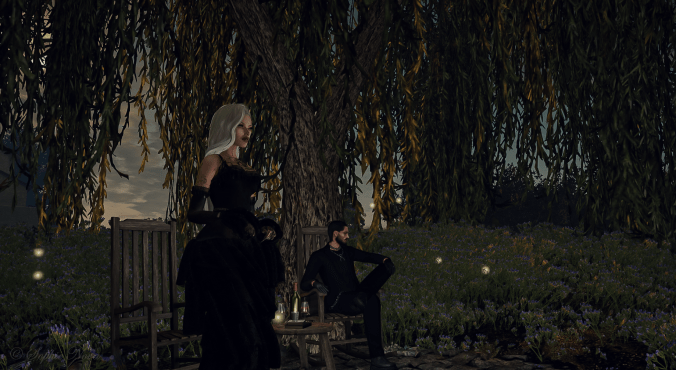
What is Absence


Absence doesn’t begin with leaving.


There’s a kind of absence that doesn’t announce itself.

It doesn’t arrive as silence, or distance, or something clearly broken.
It exists inside what still looks like connection.

At first, it feels neutral. A gap. A pause. Something temporary and easily explained.
Still speaking, still responding in all the ways that once felt natural.

At first, being present felt like a choice.
Something I offered freely.
Something that reflected how much I cared.

But slowly, that changed.

It wasn’t enough to be there.
I had to be there consistently.
Predictably.
In the right way.

If I logged in late, it was noticed.
If I left early, it lingered.
If I missed a night, it carried weight.

Nothing was said directly.
Nothing had to be.

I began to adjust without being asked.

I stayed longer than I intended.
Logged in when I was tired.
Reordered pieces of my life to make space for something that no longer felt entirely voluntary.

At the time, I told myself this was care.

That showing up mattered.
That consistency was love.

But meaning has a way of attaching itself quietly.

Not all at once. Not in ways you can point to or name.
Just a subtle shift in how something feels when it isn’t there.

Care became something I demonstrated.
Presence became something I proved.

And what had once been freely given
began to feel quietly measured.

A presence that used to be consistent, now slightly out of reach.
A silence that lingers a little longer than expected.

And somewhere in that shift, absence stops being empty.

At the time, I didn’t recognize it as loss. Loss, in my mind, required something visible—an ending, a decision, a moment you could point to and say: this is where it changed.

But that isn’t always how it happens.

Sometimes loss begins in the space between what is still happening and what is no longer being felt.

A tone that doesn’t land the same way.
A presence that feels thinner, even when it hasn’t disappeared.

And because nothing has ended, you stay.

You adjust.
You compensate.
You try not to look too closely at what feels different.

You tell yourself it’s temporary.
Or imagined.
Or something that will return if you give it enough time.

But there’s a part of you that already knows.

Not loudly.
Not urgently.

Just quietly enough to be ignored.

Until it isn’t.

Because absence doesn’t need an ending to be real.

Sometimes it’s the beginning of one.


When Absence Meant Loss


Nothing had ended yet.
But something already had.

from Chapter 5.


The change was subtle enough that I didn’t recognize it as a change. There was no single argument, no explicit demand, no clear line crossed. Instead, absence began to acquire meaning. If I logged in later than usual, the tone shifted. If I missed a night, questions appeared. If I left early, a quiet disappointment followed.

Disappointment is harder to resist than anger, because it can wear the costume of reasonableness. The Listener rarely said, Why weren’t you here? He said things like, I waited for you. Or, I thought we were going to talk. Or, I was hoping you would stay.

They weren’t framed as accusations. They sounded like longing. There were no raised voices, no ultimatums—just the quiet pressure to prove I belonged. And I responded the way people do when they believe they are being missed—with reassurance, apology, and accommodation.

Slowly, the unspoken rules became clearer. Being present was no longer a gift; it was an expectation. Absence required explanation. Availability became a measure of commitment.

“I waited for you.”

It was not said as an accusation. It didn’t need to be. The weight of it did the work on its own.

The Listener began to treat absence as evidence. Not explicitly. Never directly. But the pattern emerged in the aftermath of time apart. If I had been offline, he felt distant when I returned. Conversations tightened. Warmth cooled. I became aware—slowly, uneasily—that I was being evaluated. Had I proven my devotion, or failed it?

I worked harder to reassure him.

That was the moment obligation took root.

I was no longer logging in because I wanted to talk. I was logging in because I did not want to lose what we had.

“I thought you cared.”

It wasn’t said in anger. It was said quietly, almost sadly. Which made it harder to challenge – and easier to accept as truth.

By the time I recognized that my availability was no longer freely given, withholding it felt like a risk I couldn’t afford.

And that was when absence became loss.


When Quiet Begins to Mean Something

Meaning does not arrive as interpretation.
It arrives as recognition.


There is a moment that happens quietly.
So quietly you almost miss it.

Nothing changes on the surface.
No declaration. No realization that feels dramatic or important.
Just a subtle awareness that something familiar inside you is no longer reacting the same way.

For a long time, calm is simply experienced.
It feels like relief… like space… like the absence of pressure.

But eventually something else happens.

You begin to notice what that calm is doing to you.

Your body settles faster.
Your thoughts don’t race ahead searching for explanation.
Silence no longer feels like something that needs to be filled.

You stop bracing without deciding to stop.

And that is when quiet begins to mean something.

Not because the moment itself changed —
but because you did.

Meaning does not arrive as interpretation.
It arrives as recognition.

Recognition that safety is not temporary.
Recognition that presence does not require effort.
Recognition that connection can exist without urgency shaping it.

At first, this awareness feels fragile.
You don’t want to disturb it by naming it too quickly.

So you observe.

You notice how different it feels to exist without managing emotional temperature.
Without scanning for the shift that always used to come next.
Without preparing to explain yourself before anything has even happened.

Nothing is being asked of you.

And that absence — once unfamiliar — begins to feel natural.

This is the point where calm stops being relief…
and starts becoming meaning.

Not meaning about the other person.
Not meaning about the future.

Meaning about yourself.

About what your nervous system now recognizes as safe.
About what your body no longer mistakes for danger.
About the kind of presence you can remain inside without disappearing.

It is a quiet shift.
Almost invisible from the outside.

But internally… it changes everything.

Because once calm has meaning,
you no longer experience it accidentally.

You begin to recognize it.
Protect it.
Choose it.

And choice is where everything that follows begins.

When Calm Holds

Some changes do not arrive with intensity.
They do not announce themselves as turning points.
They emerge quietly — through repetition, through consistency, through moments where nothing demands explanation.

This is what calm felt like when I first encountered it not as absence… but as presence.

from Chapter 17.


Calm was not something I recognized immediately.

At first, I mistook it for distance. For lack of interest. For something missing.

In my experience, connection had always announced itself loudly: through urgency, intensity, constant availability. Silence had meant withdrawal. Space had meant punishment. Calm had never been neutral; it had always been a precursor to loss.

So when Kenji didn’t push, didn’t press, didn’t escalate, I didn’t know how to place him.

Our conversations continued without momentum. Short check-ins. Shared jokes. Links to music. Observations about the absurdity of Second Life: sim lag, bad animations, DJs who talked too much over their sets. Nothing that demanded continuation. Nothing that required interpretation.

And yet, he was always there.

Not hovering. Not waiting. Just present.

I noticed patterns before I noticed feelings.

He showed up when he said he would. He didn’t disappear without explanation. When he logged off, he said goodnight. When he was busy, he said so plainly, without apology or guilt. There was no strategic absence, no silence engineered to provoke response.

In the chat logs from that period, what stands out now is not what was said, but what never appeared. No pressure. No emotional ultimatums. No baiting language. No spikes of intensity followed by withdrawal. Just steady, ordinary exchange.

That consistency felt unfamiliar in my body.

I kept waiting for the turn, the moment when calm would tip into control, when steadiness would reveal itself as disinterest or manipulation. My instincts, trained by chaos, scanned constantly for what I must be missing.

But nothing arrived.

The suggestion to move to Skype came without ceremony. Not as escalation. Not as proof of intimacy. Just practicality.

It’s easier to talk there sometimes.

We didn’t turn on cameras. There was no performance implied. Just text at first, then eventually… voice.

I remember hesitating before that first call. Voice made people real in a way text didn’t. Tone carried intention. Silence could no longer be edited or delayed. In my past, voice had often meant volatility; volume, sharpness, emotional urgency disguised as closeness.

I expected nerves.

What I felt was ease.

His voice was calm. Steady. Warm without trying to persuade or impress. He didn’t rush to fill silence. He didn’t talk over me. When I spoke, he listened—not passively, not strategically, but as if my words were simply worth holding.

There was no interrogation. No probing. No emotional excavation disguised as curiosity.

We talked about ordinary things. Workdays. Family. Music that shaped us. The differences between cultures, between languages. We talked about Second Life the way people talk about a place they’ve lived, not as fantasy, but as shared geography.

Sometimes we talked late into the night. Sometimes we didn’t.

No tally was kept.

That was the part that unsettled me most.

There was no sense that time together had to be maximized to be valid. No anxiety about gaps. No urgency to define what we were doing while we were doing it.

One evening, after we logged off, I noticed something before I understood it.

My chest felt quiet.

Not empty. Not aching. Just still.

I wasn’t replaying the conversation, searching for hidden meaning. I wasn’t calculating when I’d hear from him again. I wasn’t negotiating my value through responsiveness or availability.

I trusted that he would be there again.

That trust did not arrive all at once. It accumulated slowly… through dozens of small, unremarkable moments where nothing went wrong. Moments where I expected rupture and found none.

He never raised his voice. He never demanded reassurance. He never asked me to prove anything.

And without planning to, I began to tell him things.

Not confessions. Not trauma narratives. Just truths – offered naturally, without bracing for how they might be used. The chat logs reflect this shift subtly: longer pauses, more reflective language, fewer defensive qualifiers.

I was choosing what to share.

I noticed something else too.

I was calmer with him than without him.

Not excited calm. Not anticipatory calm. But regulated. My nervous system settled in his presence. My thoughts slowed. I didn’t feel the need to manage, perform, or rescue.

That frightened me more than intensity ever had.

Because calm required trust.

And trust meant risk.

I didn’t call what was forming love. I didn’t name it at all. I told myself we were friends: just friends…because that felt safe, contained, reversible.

But friendship, real friendship is its own form of intimacy.

And quietly, without spectacle or force, something shifted.

Not because he demanded it.
Not because I needed it.
But because nothing in him threatened me.

For the first time, calm did not feel like absence.

It felt like space I could step into.

And that is how intention begins; not with urgency, not with declaration, but with the decision to stay present when nothing is pulling you forward or pushing you back.

Calm was unfamiliar.
But for the first time, unfamiliar did not feel dangerous.
It felt like space I could step into without explanation.

There was nothing urgent pulling me forward.
Nothing missing that demanded pursuit.

Just the quiet sense that connection could exist inside an ordinary moment –
one that did not need preparation, momentum, or a weekend to justify it.

Calm did not arrive as a promise.
It arrived as permission.


Calm does not always feel meaningful when it first arrives.
Sometimes it feels unfamiliar. Sometimes it feels quiet to the point of invisibility.

But over time, steadiness becomes recognizable.
And recognition becomes trust.

Learning to Stay

Some forms of staying happen quietly, without asking to be seen.


There was a time when staying felt like effort.
Like something that had to be justified, negotiated, or constantly reinforced.

I didn’t know how to remain without performing.
Didn’t know how to exist in connection without checking for shifts in tone or meaning.
I believed presence required proof.

What I am learning now is that staying does not announce itself.
It doesn’t arrive with declarations or momentum.
It shows up quietly, again and again, without asking to be witnessed.

Some forms of connection are not built through intensity.
They are built through repetition.
Through showing up without insistence.
Through letting moments end cleanly, without rushing to extend them.

I used to mistake calm for absence.
Silence for disinterest.
Space for something unfinished.

Now I recognize a different truth:
staying is not something you force.
It’s something that happens when nothing is pulling you away.

There is a steadiness in this kind of presence.
A rhythm that does not spike or collapse.
A sense of being held – not by promises, but by consistency.

Nothing needs to be secured here.
Nothing needs to be clarified before it can exist.

Staying, I’ve learned, is not about holding on.
It’s about not leaving yourself in order to remain.

And when staying no longer feels like effort,
you begin to understand
you’re finally where you are meant to be.


This week I also shared a more personal piece on the blog about my grandmother and the kitchen where I first learned to bake. If you missed it, you can read it here: The First Cookie.