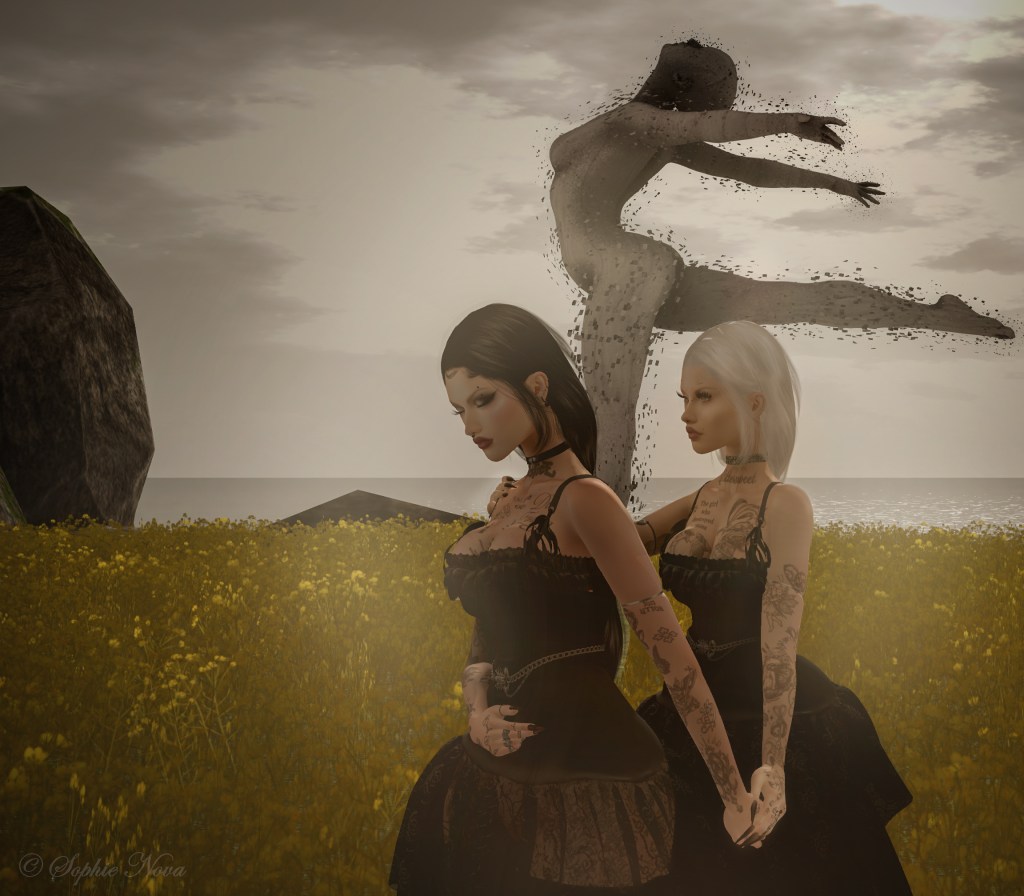
Not a replacement. A continuation.
The restraining order created quiet. Quiet is not the same as peace.
from Chapter 16.
He contacted me out of the blue.
Not in the way that surprises you when you have been expecting silence — but in the way that confirms something you already knew. That ending something does not mean it stops reaching for you. That the pattern does not end because you have ended it. That reaching is what some people do instead of stopping.
It had been months since October. The last contact, the last message through whatever surface remained unblocked, had come and gone without response. I had not answered then. I had almost walked away from Second Life on September 1, 2015 — one year after Sophie had been created — and nearly missed everything that came next. The silence I had chosen was holding.
And then January 5, 2016.
Two attempts on the same day. One message, cordial and casual — I’m not mad, I hold no hate, I have stories, some scary ones, I think you’d find them interesting. The hook embedded in the warmth. The manufactured reason to respond. And the second, a notecard in SL, longer, more exposed — the full accounting of what he claimed to have learned, what he claimed to feel, what he needed me to know about the Casualty and himself and the love he had never stopped carrying
I read both. I did not respond to either.
What I did instead was this.
I took a screencap of his contact. His reach, his words, the evidence of what he was still doing. I put it in a notecard. I sent it to the Casualty.
I do not wish to be contacted. If this is true, please seek help.
That was all.
I did not defend myself to her. I did not attack him. I did not explain the years or the store or the restraining order or the decade of creative work I had left behind to have peace. I did not ask her to believe me or to leave him or to understand what she had walked into.
I simply named what I wanted — to be left alone — and offered her the option of knowing what she was living inside.
She deserved that option.
I had not been given it.
There is something I want to say carefully here, because it matters.
The Casualty was a troubled woman. I knew that, even then. She had her own damage, her own history, her own reasons for being where she was. She was not my enemy. She was not my concern. She was someone who had ended up in the same orbit and was, in her own way, navigating the same gravitational pull I had spent seven and a half years trying to escape.
What I sent her was not a weapon.
It was a window.
Whether she looked through it was not mine to determine.
The June 12 email had arrived seven months earlier, after I had already said goodbye.
He did not know I was already gone when he wrote it. He wrote as though the door was still ajar — as though enough words, the right words, the honest words, might find the opening he needed. He took specific blame. He named specific failures. He said I failed you in plain language, which is more than he had managed in seven and a half years of failing me.
He said anger management classes were starting next month.
He said he was ashamed.
He said there was no woman in the world he wanted more than me.
I read it. I did not respond.
Not because the words were meaningless. Some of them were true — the grief over his father was real, the shame was real, the love in whatever form he understood it was real. People can be genuinely sorry and still be the same person who did everything they did. Remorse and accountability are not the same thing. And a door that has been broken enough times does not become a door again because someone finally admits they were the one breaking it.
I had already left.
The email arrived into a space where there was no longer anyone waiting to receive it.
After January 5, 2016, he was quiet.
I do not know what the Casualty did with the notecard. I do not know what she said to him or whether she sought the help I mentioned or whether the window I offered her was one she chose to look through. That was never mine to know.
What I know is that after January 5, the contact stopped.
Not because he had finally understood. Not because anything had resolved. But because I had made myself unreachable in every direction simultaneously — and because the one response I had offered was not to him.
I had answered the Casualty instead of The Counterpart.
That distinction is the whole ending.
He had spent seven and a half years making himself the center of every story — the talented artist, the grieving son, the devoted lover, the wronged partner, the man who never stopped loving me. Every reach, every poem, every apology, every accusation had been constructed around the premise that I would respond. That I was still inside the story with him. That my silence was temporary, my resistance negotiable, my attention still available if he found the right combination of words.
The notecard to the Casualty was my answer to all of it.
Not to him.
To her.
Seven and a half years.
A decade of creative work left behind.
A house. A restraining order. A name that was no longer mine.
And in the end, closure did not arrive through him.
It arrived through refusal.
Not confrontation.
Not explanation.
Not one final conversation where everything was finally understood.
Just a screencap.
A notecard.
Two sentences sent to someone else entirely.
I do not wish to be contacted. If this is true, please seek help.
That was all.
It was enough.

