What I Built

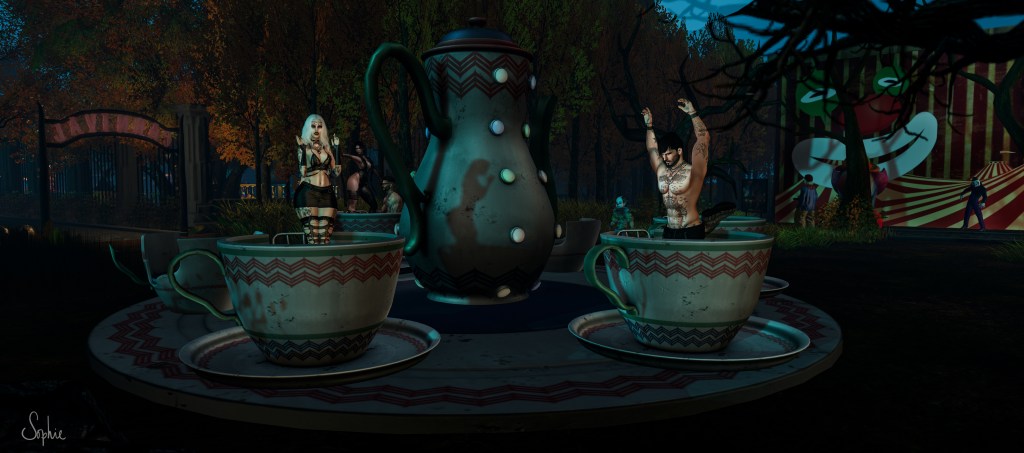
Photo Note: A render from 2010. By then, much of what people associated with his name already carried my fingerprints.


Some things begin as care and become invisible over time.

from Chapter 11.


I gave him space before I gave him anything else.

That is the part that becomes difficult to remember later — that it did not begin as sacrifice. It began as care. I had land in Second Life, prims to spare, enough room to build something if someone needed a place to begin. And he did.

He had the kind of talent that unsettles you a little when you first encounter it. Not polished talent. Not the kind the world rewards easily. Something rougher than that. Something instinctive. He could build things that felt like they had lived somewhere before they arrived on a screen — dark cathedrals, fractured machinery, pieces that carried atmosphere inside them.

I understood that kind of creativity immediately because I had spent years around people who carried entire worlds inside themselves and nowhere stable to place them.

So I made room for him.

The Listener had been softness — romance, fantasy, warmth carefully arranged into beauty. The Counterpart was different from the beginning. Darker. Industrial. Sharp-edged. His world was metal and shadows and neon and ruin. Vampiric things. Cyberpunk things. Places that looked abandoned and alive at the same time.

I was drawn to the contrast as much as the person.

The first sets were mine.

Small things, carefully made — silks and caps built from techniques I had spent time developing myself. Tiny prim work. Delicate alignment. The sort of detail most people never notice unless they have built something by hand before.

He took what I made and extended it.

Veils. Variations. Additional pieces that grew outward from the foundation already there. That was how we actually began creatively — not by building the same thing together from the start, but by him stepping into something I had already created and expanding it outward into his own vision.

Later, the work became more intertwined.

He imagined quickly. I refined patiently.

He would rough out the structure of an idea, texture something half-finished at three in the morning, build the atmosphere of it. I would take what he made and finish the parts no one notices until they are missing — the alignments, the scripts, the permissions, the packaging, the notecards, the listings, the advertisements, the marketplace updates after I had already worked a full day somewhere else.

He made the vision feel alive. I made the vision function.

At the time, neither of us said the distinction aloud.

We built the storefront together. Dark stone. Cathedral scale. Purple light spilling across black floors. A portal suspended above the entrance like something opening.

In the beginning, we was still an honest word.

There was excitement in it then. The particular intimacy of building something alongside someone you loved. Long nights working while music played in the background. Conversations folded between textures and scripts and half-finished ideas. The feeling that the two of you were creating not just objects, but a world.

At some point — not dramatically, not on a day I could name — the we quietly became me.

The store became a second job. His creative timeline became my deadline. If I came home exhausted and did not want to log in after work, it became part of the reason things were not succeeding the way they should. His vision remained the center of gravity. My role became sustaining it.

I do not think he saw it that way. I think, genuinely, he believed he was the one sacrificing more. My work existed in his mind differently. I was supporting the household because I had to. He was creating because it mattered.

The contradiction inside that belief never fully reached him.

In his SL profile, he described me as artist, gamer, creator, scripter, sim builder, and co-owner of the store. He saw what I was. He named it publicly, in his own words, in the space where he chose what to say about himself and the people in his life.

He knew I built things. He said so. He simply made sure the things I built carried his name.

That is not oversight. That is a choice.

I kept building anyway.

Through the Wisconsin years, through the financial architecture of a household I carried alone, through the arguments and the cycles and the moments that required swallowing — I kept making things. Collections named for goddesses, built by hand, listed under my own name on my own marketplace page. The dates are still there, stretching back through all of it.

I was making things the whole time.

That is the part of the story that belongs to me and cannot be revised. Whatever else was happening — whatever was being called mine that wasn’t, whatever of mine was being called his — I was creating. Quietly. Continuously. Under my own name.

By the time people knew the store by his name, my hands were already in its foundations.

The store that carries my name still remains.

I built both of them.


The Illusion of Control


I believed understanding the storm would protect me from it.

from Chapter 10.


By the time The Counterpart entered my real life, I believed I understood what danger looked like, because I had already survived the fire. I had survived a relationship that never left the screen but rearranged my nervous system anyway. I had learned the language — withdrawal, conditioning, intermittent reinforcement. I believed awareness was protection.

What I did not yet understand was that recognizing a pattern does not stop it from advancing. It only convinces you that you can manage it when it does.

With The Counterpart, the rules were visible — because he stated them like terms. He did not simply want closeness. He wanted me to accept the conditions under which I should feel grateful he had chosen me at all.

“You are older, you have kids from a previous, still married and you cant give me children. Put that into perspective please.”

“Secondlife will not be going as a sacrifice to being with you. Its time you either accept me or let me go.”

He did not hide his emotions. When he was angry, it arrived loudly and unmistakably. When he was loving, it was intense, consuming, immediate. I told myself this honesty meant safety.

And so I adjusted.

I learned which topics ignited him and avoided them. I learned how to phrase concerns gently enough to slip past his defenses. I learned when to engage and when to wait, when to soothe and when to stay silent. I believed that if I could just remain steady — if I could be calm enough, patient enough — I could keep us balanced.

This is the illusion of control: believing that emotional regulation can be outsourced.

I became the stabilizer. The emotional anchor. When he spiraled, I grounded him. When he raged, I took the impact. When he collapsed, I carried the weight. I mistook this labor for partnership. But managing volatility does not neutralize it. It only relocates the cost.

He insisted that if I loved him, I would come to Wisconsin. That was the only proof he would accept. Even then, love wasn’t something we shared. It was something I was required to demonstrate.

So I spent money I did not have and flew there.

The weekend was intoxicating. I returned home believing we were building toward something real.

In May 2009, after months of volatility I had come to accept as normal, I interviewed for a job in Wisconsin. He was pleased. My willingness to uproot my life was read as devotion. When I was offered the position, I resigned from my job in Arizona, found a house, and moved my family across the country.

Living together in real life collapsed the distance that had disguised so much — and protected me.

I worked to support all of us. Then I worked again at night — inside Second Life — trying to keep him steady. The cycle was relentless: I worked to provide, then worked again to appease.

I was not choosing peace. I was preventing explosions.

There is a particular exhaustion that comes from believing you are the only thing standing between calm and chaos. It creates urgency. Hyper-awareness. A sense that rest itself is dangerous, because something might happen while you are not paying attention.

I lived there.

What made the illusion convincing was that sometimes it worked. There were stretches of calm — days, even weeks — when my careful navigation seemed to stabilize things. The house felt quiet. The tension eased.

Those moments reinforced the belief that I could manage this.

But volatility does not disappear. It waits.

I began to understand — too late — that I was not preventing harm. I was postponing it.

Still, I stayed.

Because letting go of the illusion meant confronting a harder truth: that I could not love someone into safety, and that my effort — no matter how sincere — was not the solution I wanted it to be.

I had escaped silence by stepping into noise. And I was still trying to control the weather — just before the storm arrived.


After Fire


Some warmth you accept not because it’s safe — but because the cold was worse.

When it returned, I didn’t ask what had happened.

I didn’t ask because I already knew the answer wouldn’t matter. What mattered was that it had returned. “That the silence was over. That I was no longer alone inside the absence of it.

That is the thing no one tells you about fire.

It isn’t always about the heat.

Sometimes it’s about what you were standing in before it arrived.

I had survived being abandoned once. I had learned the shape of that particular silence — the way it settles into the body, the way it confirms every quiet fear you’ve ever had about your own worth.

That lesson did not begin with him. It began earlier — quietly, thoroughly — in the way certain childhoods teach you to read your own worth through someone else’s disappointment.

By the time he left without explanation, without repair, without a single word — my nervous system didn’t reach for anger.

It reached for evidence.

And the evidence it found was familiar.

Something I did. Something I said. Something I was, or wasn’t, or couldn’t manage to become in time.

The leaving felt like confirmation.

So when it came back — the proposal, the reset, the return as if nothing had fractured — I said yes before I could think clearly about what I was saying yes to.

Not because I trusted it. Not because it felt right.

But because yes felt like a stay of execution on the verdict I had already begun to accept about myself.

This is what no one tells you about the moments after fire.

You’re not just afraid of being cold again. You’re afraid that the cold is what you deserve.

That warmth — even unstable, even conditional, even offered without accountability — feels like being chosen.

And being chosen felt like proof that the verdict was wrong.

It wasn’t proof. It was just heat.

But I didn’t know the difference yet.

And I was so tired of believing I was the reason people left.


Familiar Fire


After frost, fire feels merciful.

from Chapter 9.


I believed I was finished — with volatility, with emotional negotiation, with mistaking intensity for intimacy. I had learned how to survive absence. I mistook that for wisdom.

So when connection returned in a different form — louder, faster, unmistakable — I did not recognize it as danger. I recognized it as life.

That is how The Counterpart entered my world.

If The Listener was absence wielded as control, The Counterpart was ignition offered as proof. Where The Listener withdrew, The Counterpart surged. Where silence once punished me, sound now claimed me. His feelings arrived without delay or filter, filling every space immediately. There was no ambiguity. No waiting. No wondering where I stood.

After frost, fire feels merciful.

He spoke in absolutes. He did not ration affection — he flooded me with it. In public spaces, in profiles, in messages meant to be seen, he named me as singular and central.

Commitment arrived before understanding.

When the proposal came, it did not ask whether I was ready. It assumed readiness was proof of love.

In Second Life, partnership is ceremonial — public, declarative, symbolic. It signals belonging. The language was total. Ownership disguised as devotion. I remember feeling swept forward not because I had decided, but because stopping would have required interrupting his emotional momentum — and I had already learned what interruption cost.

So I said yes.

I told myself this was honesty. I told myself this was safety.

After months of being made to doubt my place, certainty was intoxicating.

But certainty, too, can become a demand.

Emotions escalated without warning. Connection moved from warmth to emergency in seconds. Everything mattered immediately. Everything required response. Everything was framed as evidence of devotion.

And then, without discussion, it ended.

A system message. Impersonal. Final. No explanation attached. No space for response.

Less than a day later, the system spoke again.

A new proposal. No repair. No reckoning. No acknowledgment of what had just happened.

Just a reset.

This was the moment the fire changed.

Intensity becomes dangerous when it is no longer an expression of feeling, but a mechanism of control. When commitment is used not to create safety, but to destabilize it. When love is offered, revoked, and reoffered without repair.

The breakup was not the injury. The re-proposal was.

Because it taught me that connection could disappear without warning — and return just as easily — as long as I agreed not to ask what had happened in between.

From that point forward, stability depended on my willingness to absorb rupture quietly.

That is when intensity crossed into threat.


What Knowing Doesn’t Fix


Understanding a pattern and being free of it are not the same thing.

I knew what I had survived. I had language for it — the way absence becomes leverage, the way presence becomes obligation, the way love gets measured in what you’re willing to endure.

I told myself that knowing was enough.

It wasn’t.

A few months after everything ended, I met someone new. An artist. We talked about music, about building, about creative work that feels like it costs something. I offered him space on my sim. I told myself it was generosity.

Then, a few days later, I wrote to him.

I told him I had been thinking about him. That I could see he was standing in the center of something chaotic. That I was there to listen, anytime he needed.

I attached a poem by e.e. cummings — somewhere i have never travelled, gladly beyond.

What I didn’t say — what I hadn’t yet admitted to myself — was the real reason I reached out.

I believed I could be for him what no one had ever been for me.

I had grown up without that kind of steadiness. No one who simply stayed. No one who listened without condition or made space without asking something in return.

And without realizing it, I had begun to believe that offering that steadiness to someone else might finally make sense of not having received it myself.

What I hadn’t yet recognized was the quieter truth:

I had already done that for myself.

Everything I survived, I survived without rescue. Everything I built — my stability, my independence, my ability to keep going — I built myself. Not because no one cared. But because somewhere along the way, I learned how to carry my own weight forward.

I just didn’t know it yet.

So I reached toward someone else’s chaos instead.

With a poem.

The way I always had.

This is what knowing doesn’t fix.

The body remembers what it was trained for long before the mind catches up.