Not every turning point announces itself. Some arrive quietly, without urgency or spectacle. This is one of those moments.
from Chapter 19.
Nothing important happened to me the first time I met Ken.
That is not false modesty or revision. It is the truth.
There was no spark. No pause in time. No internal shift announcing significance.
He was a name.
An avatar.
One person among many.
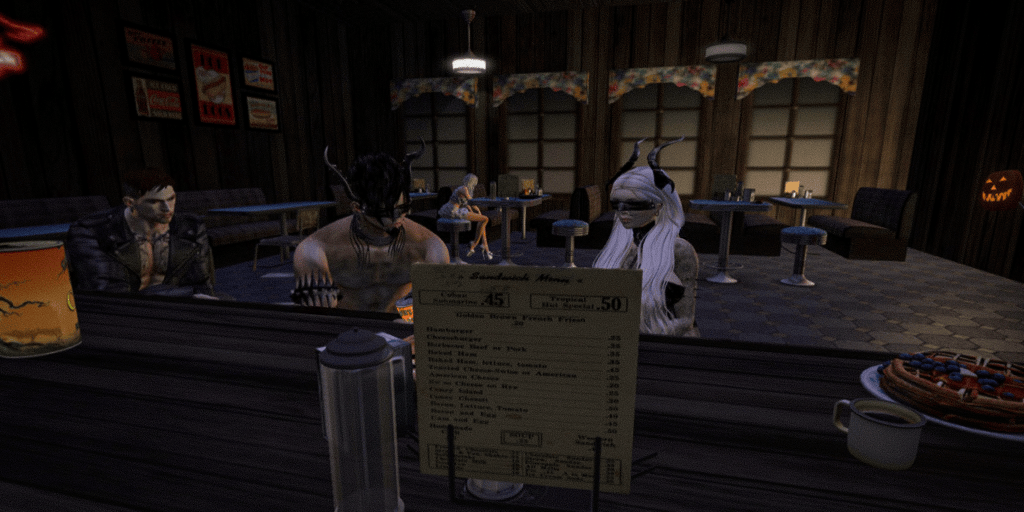
By then, Second Life was a world I moved through without thinking much about it. Clubs, DJs, friends, photography, Bloodlines, late nights that wandered from one place to another depending on where everyone happened to be.
There was always something going on.
I wasn’t looking for a relationship.
I wasn’t really looking for anything.
Photography had become one of the things I loved most. I could lose hours setting up a shot, changing the light, trying poses, moving the camera a fraction at a time until something finally looked the way I wanted it to.
And when I wasn’t doing that, I was usually with friends. That was how I met Ken.
A group of us were playing Greedy.
He was there with his girlfriend. I spoke more to her than I did to him.
He said hello. I said hello back. That was it.
No private messages afterward.
No reason to wonder who he was.
No moment I went back and replayed later that night.
I don’t even remember much about the conversation.
If you had asked me afterward whether I’d met anyone interesting, I’m not sure his name would have occurred to me.
And then life continued.
I hosted. Took photographs. Spent time with friends. Stayed up later than I should have. Went to work the next morning and did it all again.
Ken went wherever Ken went.
I went wherever I went.
For a while, our paths didn’t cross.
There is a temptation, knowing what happened later, to search that first meeting for something.
A look. A feeling. Some tiny sign that should have told me this person would eventually change my life.
I had learned to live inside urgency so completely that stillness felt like risk.
From Chapter 18.
For a long time, I believed movement was survival.
Staying busy meant staying safe. Responding quickly meant staying connected. Adjusting meant staying loved. I had learned to live inside urgency so completely that stillness felt like risk. Even after the restraining order, even after the violence had been named, my body still expected demand.
It took time to understand that safety does not announce itself. It arrives quietly — and often feels wrong at first.
There was no moment where I declared myself healed. No ceremony marking the return of autonomy. What changed instead was subtle. I began to notice pauses where I once rushed. Spaces where I no longer filled the silence. Invitations I declined without explanation. Messages I did not answer immediately — not as punishment, not as strategy, but because I no longer felt compelled to.
Choice returned in increments.
In Second Life, I logged in without expectation. I showed up to host shifts, greeted familiar names, danced without watching who watched me back. Music washed over me without becoming a signal. I was present without being exposed.
At first, this felt uncomfortable. Almost irresponsible. I had been trained to believe that love required responsiveness, that care meant availability, that rest was something you earned only after everyone else was settled. Now there was no one to manage. No volatility to stabilize. No emotional weather system demanding my attention.
Without urgency, I felt exposed. But exposure was not the same as danger.
I began paying attention to my body in ways I never had before — not to monitor threat, but to register truth. Tightness. Ease. Curiosity. Aversion. I noticed how certain voices — certain styles of attention — still triggered a familiar pull. The instinct to soothe. To explain. To prove.
And I noticed something else, too: how quickly that pull faded when I didn’t follow it.
Intensity, once magnetic, now registered as noise. The sharp edge of charm felt less like excitement and more like pressure. I had learned, finally, that attraction does not have to feel like acceleration. That calm is not the absence of chemistry. It is the presence of safety.
Being alone was not the hardest part. The hardest part was not performing.
Healing, I learned, is not a revelation. It is repetition.
The body relearns safety through ordinary moments. Through calm that does not spike. Through the sustained absence of threat. Slowly, my instincts recalibrated. What once felt exciting now felt loud. What once felt romantic now felt rushed. I stopped confusing intensity with intimacy.
There was no one to impress. No one to convince. No one whose mood determined the temperature of my day. I was no longer required to be useful in order to belong. And without that requirement, I faced a quieter question:
Who am I when no one is asking anything of me?
For years, love had been something I survived — something I endured, managed, negotiated. I had mistaken intensity for depth, proximity for intimacy, endurance for devotion.
Without realizing it at first, I was learning something else entirely.
Love — real love — does not require collapse. It does not ask you to disappear to prove you care. It does not demand urgency to feel alive. It does not punish pause.
I chose solitude over repetition. I chose quiet over explanation. I chose to stay inside my own life, even when it felt unfamiliar, even when it felt empty, even when part of me still believed that love was supposed to arrive with force.
What I did not know yet — what I could not have planned for — was that something entirely different becomes possible once urgency releases its grip.
Not because you are searching. But because you are no longer willing to disappear.
And that is when choice stops being theoretical. It becomes lived.
The restraining order did not create peace immediately.
What it created first was disorientation — a silence so abrupt my body did not know what to do with it. For years, my nervous system had been organized around vigilance. Reading moods. Anticipating shifts. Managing the temperature of every room before anyone else felt the change. When that work was removed by law, what remained was not relief.
It was a vacuum.
Safety, I learned, is not the same as calm.
In the weeks that followed the courtroom, I moved through my own life as if it belonged to someone else. I slept lightly. I startled easily. I kept listening for sounds that never came. My mind replayed events I could no longer change, while my body remained braced for impact that did not arrive.
This is the phase people rarely talk about.
After escape comes disorientation. After safety comes grief. After control breaks, there is a vacuum where urgency once lived. I was no longer managing his emotions or negotiating outcomes — but I had not yet relearned how to occupy my own life without apology.
The relationship had ended. The conditioning had not.
And recovery, I would learn, is not the absence of harm — it is the slow reclaiming of independence.
Replaying the courtroom scene in my head, I remembered how the emails sounded when they were read aloud. The words no longer belonged to him. They belonged to the record. Stripped of context and emotion, they revealed what I had lived inside of for years.
Abuse does not sound ambiguous when it is read by someone else.
The judge did not look at me when he spoke. He addressed him directly — firmly, without hesitation. There was no softening, no room for reinterpretation. I watched as authority named what I had been trained to minimize.
I did not cry from shame. I cried because I was finally believed.
I had been taught that love meant responsibility. If someone was hurting, it meant I hadn’t done enough yet. That belief began long before any man entered my life. It began in childhood, where peace depended on my ability to anticipate needs, absorb blame, and stay quiet.
So when I did everything and was still told it wasn’t enough, it did not register as injustice. It felt familiar.
Leaving felt wrong. Staying felt like duty.
He did attempt contact.
It came framed as remorse and necessity — lost possessions, regret, longing. And in those early months of 2015, I was not as steady as I wanted to be.
The restraining order had created a legal boundary. It had not yet created an internal one. My nervous system still reached for the familiar, even when familiar was the thing I was trying to escape. I met him. More than once. Not because I had forgotten what he was — but because the silence he left behind was so complete I did not yet know how to stand inside it without reaching for something to hold.
I almost let him back in.
I want to name that plainly, because pretending otherwise would be a lie, and this story has no room for those.
What stopped me was not a revelation. Not a dramatic moment of clarity. Just the slow accumulation of evidence that nothing had changed — that the warmth he offered was the same warmth that had always preceded the cold, and that I had finally learned to recognize the sequence before it completed itself.
I stated what was already true: too much had happened. There was no version of us left to repair.
I said goodbye. I blocked his number. I told myself this time the boundary would hold.
It held.
I did not replace him with anything lasting. But I did reach — toward connection, toward distraction, toward the familiar pull of people who were broken or unavailable in their own ways. Brief relationships that ended as abruptly as they began. Each one confirmed something I was still learning to trust: that I could see the pattern now, even while moving through it. That recognition, however imperfect, was its own form of progress.
What I had learned — painfully — was that loneliness was not my greatest danger.
Patterns were.
So I stayed as steady as I could. And when the reaching stopped working, I stopped reaching.
There is a strength that only grows in silence — the strength to sit with yourself without performance, without rescue, without being needed.
I did not yet trust my instincts fully, but I was learning to trust my boundaries.
Slowly, my body began to settle. The vigilance softened. The fear loosened its grip. I stopped bracing for impact. I stopped waiting for the next explosion.
That quiet was not dramatic. There were no epiphanies. Just breath. Just space.
And in that space — unoccupied, unguarded, honest — I was no longer trying to survive love.
The restraining order created quiet. Quiet is not the same as peace.
from Chapter 16.
He contacted me out of the blue.
Not in the way that surprises you when you have been expecting silence — but in the way that confirms something you already knew. That ending something does not mean it stops reaching for you. That the pattern does not end because you have ended it. That reaching is what some people do instead of stopping.
It had been months since October. The last contact, the last message through whatever surface remained unblocked, had come and gone without response. I had not answered then. I had almost walked away from Second Life on September 1, 2015 — one year after Sophie had been created — and nearly missed everything that came next. The silence I had chosen was holding.
And then January 5, 2016.
Two attempts on the same day. One message, cordial and casual — I’m not mad, I hold no hate, I have stories, some scary ones, I think you’d find them interesting. The hook embedded in the warmth. The manufactured reason to respond. And the second, a notecard in SL, longer, more exposed — the full accounting of what he claimed to have learned, what he claimed to feel, what he needed me to know about the Casualty and himself and the love he had never stopped carrying
I read both. I did not respond to either.
What I did instead was this.
I took a screencap of his contact. His reach, his words, the evidence of what he was still doing. I put it in a notecard. I sent it to the Casualty.
I do not wish to be contacted. If this is true, please seek help.
That was all.
I did not defend myself to her. I did not attack him. I did not explain the years or the store or the restraining order or the decade of creative work I had left behind to have peace. I did not ask her to believe me or to leave him or to understand what she had walked into.
I simply named what I wanted — to be left alone — and offered her the option of knowing what she was living inside.
She deserved that option.
I had not been given it.
There is something I want to say carefully here, because it matters.
The Casualty was a troubled woman. I knew that, even then. She had her own damage, her own history, her own reasons for being where she was. She was not my enemy. She was not my concern. She was someone who had ended up in the same orbit and was, in her own way, navigating the same gravitational pull I had spent seven and a half years trying to escape.
What I sent her was not a weapon.
It was a window.
Whether she looked through it was not mine to determine.
The June 12 email had arrived seven months earlier, after I had already said goodbye.
He did not know I was already gone when he wrote it. He wrote as though the door was still ajar — as though enough words, the right words, the honest words, might find the opening he needed. He took specific blame. He named specific failures. He said I failed you in plain language, which is more than he had managed in seven and a half years of failing me.
He said anger management classes were starting next month.
He said he was ashamed.
He said there was no woman in the world he wanted more than me.
I read it. I did not respond.
Not because the words were meaningless. Some of them were true — the grief over his father was real, the shame was real, the love in whatever form he understood it was real. People can be genuinely sorry and still be the same person who did everything they did. Remorse and accountability are not the same thing. And a door that has been broken enough times does not become a door again because someone finally admits they were the one breaking it.
I had already left.
The email arrived into a space where there was no longer anyone waiting to receive it.
After January 5, 2016, he was quiet.
I do not know what the Casualty did with the notecard. I do not know what she said to him or whether she sought the help I mentioned or whether the window I offered her was one she chose to look through. That was never mine to know.
What I know is that after January 5, the contact stopped.
Not because he had finally understood. Not because anything had resolved. But because I had made myself unreachable in every direction simultaneously — and because the one response I had offered was not to him.
I had answered the Casualty instead of The Counterpart.
That distinction is the whole ending.
He had spent seven and a half years making himself the center of every story — the talented artist, the grieving son, the devoted lover, the wronged partner, the man who never stopped loving me. Every reach, every poem, every apology, every accusation had been constructed around the premise that I would respond. That I was still inside the story with him. That my silence was temporary, my resistance negotiable, my attention still available if he found the right combination of words.
The notecard to the Casualty was my answer to all of it.
Not to him.
To her.
Seven and a half years.
A decade of creative work left behind.
A house. A restraining order. A name that was no longer mine.
And in the end, closure did not arrive through him.
It arrived through refusal.
Not confrontation.
Not explanation.
Not one final conversation where everything was finally understood.
Just a screencap.
A notecard.
Two sentences sent to someone else entirely.
I do not wish to be contacted. If this is true, please seek help.
Some silences are taken from you. Some you choose. They do not feel the same.
There is a difference between silence imposed and silence chosen. I had lived inside the first kind for over a year. I thought I understood what quiet cost.
I did not yet understand what it cost to choose it yourself.
When I logged off on September 1, 2015, I told myself it was recognition. That I had seen the pattern repeat inside Sophie and caught it faster than before. That this was progress. That walking away was the right and healthy thing to do.
What I felt was not progress.
What I felt was grief. And underneath the grief, something colder — a verdict I had been building against myself for years and had finally stopped arguing with.
I had come out of one relationship that rearranged my nervous system. I had walked directly into another that did the same thing and worse. I had survived that one, barely, through a restraining order and the slow agonizing work of blocking every surface of my life against someone who treated a court order as an inconvenience. And then I had built Sophie — a new name, a new face, a new world he could not enter — and I had been so certain that this time the story would go differently.
It didn’t.
Different person. Different world. Same pull toward complexity. Same mistaking of difficulty for depth. Same ending — abrupt, painful, the particular hollow feeling of having been lied to and gaslit and left.
I sat with that for a long time after September 1.
Not heroically. Not with the clean clarity of someone who has learned something and is ready to move forward. Just sitting with it the way you sit with something that confirms what you feared was true — quietly, without fighting it, because fighting it had started to feel like more effort than it was worth.
Something must be broken in me.
That was the thought. Not a passing one. A settled one. The kind that doesn’t announce itself dramatically but simply takes up residence, the way certain beliefs do when they have enough evidence behind them and you have run out of arguments against them.
I thought about my father.
He had not remarried after my parents split. He had dated twice, briefly, and then he had stopped. Not bitterly — he was not a bitter man. Just quietly. As if he had done the math and arrived at a conclusion he could live with. Alone was something he understood. Alone was manageable. Alone did not require the particular kind of hope that kept getting disproven.
I understood that for the first time on September 1, 2015.
Not as resignation exactly. As recognition. Maybe some people are built for this. Maybe the pattern I kept repeating wasn’t a problem to be solved but a fact to be accepted. Maybe the kindest thing I could do — for myself, for anyone who might get close to me — was to stop trying.
I had wasted so much time.
That was the other thing underneath the grief. Not just the relationships but the years. The Wisconsin years. The Sophie year. The decade of creative work I had left behind to have silence. The teenagers I had not been fully present for because I was managing someone else’s volatility inside the house that was supposed to be their safe place.
You cannot get time back. You can only decide what to do with what remains.
What I decided, on September 1, 2015, was that what remained should be spent alone. Quietly. Without the particular kind of hope that had kept getting disproven.
I thought that was wisdom.
It was actually the deepest version of the lie I had been told about myself for years — that the damage was mine, that the pattern was mine, that something in me called these things toward me and kept them there.
I didn’t know that yet.
What I knew was that I was tired. And that the silence I had chosen, unlike the one imposed by law, felt like it might actually hold.
It might have.
But a friend would not let me disappear quietly.
And everything that came after — the return, the introduction, the slow arrival of something I had stopped believing existed — began not with my own courage or clarity.
It began with someone who saw me choosing to disappear and said: not yet.