The restraining order created quiet. Quiet is not the same as peace.
from Chapter 15.
The restraining order created silence.
I did not know what to do with it.
For years, my nervous system had been organized around presence — his moods, his needs, his volatility, the constant low-grade work of managing someone else’s weather. When that presence was removed by law, what remained was not peace. It was a vacuum. The absence of noise so complete it felt like a physical thing, pressing in from all sides.
My sons were in high school by then — twins navigating the particular world of teenagers, busy with their own lives in the way that is exactly as it should be. The house was quieter than it had ever been. I was forty-something, alone in rooms I owned, trying to locate a version of myself that had not been defined by someone else’s chaos.
I did not find her immediately.
What I found first was fear.
The fear was specific and humiliating in the way honest fears always are. I was a woman in her forties, with three sons and two failed relationships and a restraining order and a decade of creative work she had been forced to abandon. I told myself there was no version of this story that ended with someone choosing me. That the market for what I was — damaged, complicated, tired — did not exist.
That fear made decisions for me in early 2015.
I met The Counterpart at hotels. Two or three times. Not because I had forgotten what he was. Not because I believed anything had changed. But because the body does not automatically understand what the court order means, and familiar is what the nervous system reaches for when it does not know what else to do.
I understood what I was doing even as I was doing it. That is the particular cruelty of that stage of leaving — the awareness without the ability to stop. I was not confused about who he was. I was confused about who I was without him as a reference point.
I stopped. Not dramatically. Not after a revelation. Just gradually, the way you stop doing something when you have run out of reasons to continue. I said goodbye. I blocked his number. I told myself this time the boundary would hold.
It held.
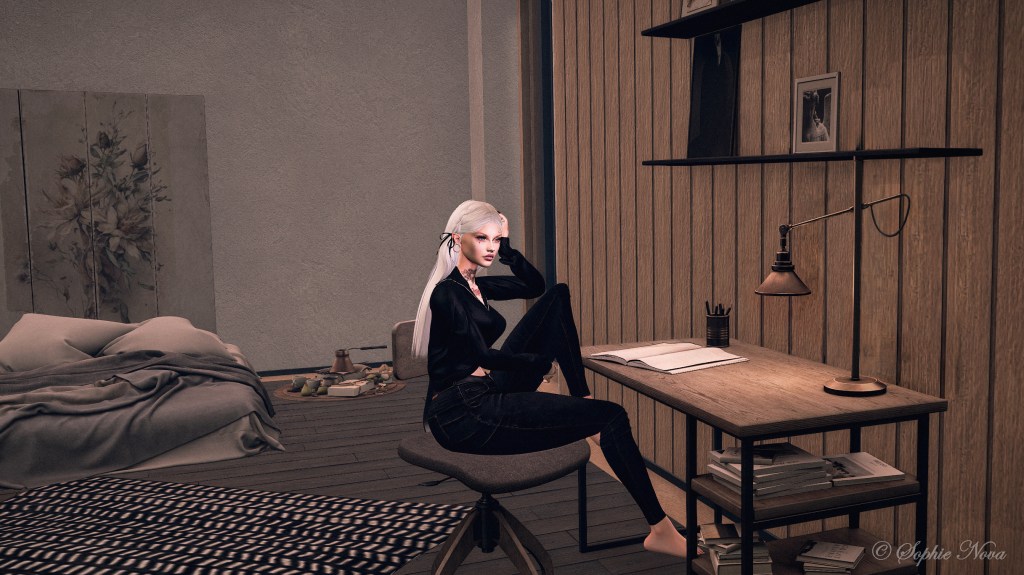
In Second Life, Sophie was alive.
She was SophieCatherine then — named for a woman who had built an empire from an unlikely position, whose achievements had been obscured by the noise of her personal life, who was more astute and skillful than anyone who dismissed her understood. I had put the history in my profile deliberately. Anyone who asked about the name would know it wasn’t random.
I was writing the person I intended to become into existence before I had fully become her.
Sophie had a family. Not by accident — by choice, the way you choose things when you finally understand that choice is available to you. Sisters: Tylar, who knew what was happening in my real life and held it carefully; Viczen, Danni, and Leena, each with their own particular presence in the world we shared. A brother — Bronson — who was my best friend in the particular way that SL friendships can be, equal parts mischief and loyalty. When we were not causing trouble in SL, we were playing PlayStation together, the easy companionship of two people who had found their rhythm.
He once described a photo of us as a pair of good looking motherfuckers. I put it in my profile. It stayed there.
That family was the architecture of 2015. The thing that held the shape of the year when everything else was formless. They were not a replacement for what I had lost. They were something different — chosen, uncomplicated by history, present without demand.
And at the end of my profile, in my own words:
For just once in my life, I want to be the one that has the happy ending. Do you exist or simply a myth?
I was asking a real question. I did not yet know the answer.
The reaching continued in the wrong directions for a while longer. I sought connection through people who were broken or unavailable in their own ways — drawn to them by the familiar pull of complexity, the old reflex that mistook difficulty for depth. The pattern repeated, smaller and faster than before, because I could see it now even as I moved through it.
That was progress, even when it didn’t feel like it.
I was still reaching.
But I was reaching in the same directions I always had, and finding the same things there.
On September 1, 2015 — one year since Sophie had been created — I logged off with the intention of not going back. I thought that recognition was enough to walk away from all of it.
It might have been.
But a friend would not let me disappear quietly.
The Counterpart was still there in October — one last message, one last reach through whatever surface remained unblocked. I did not respond.
After that, he was quiet.
I do not know what made him stop. I only know that he did.
And I was already somewhere he could not find me.
Not because I had hidden.
Because I had finally, slowly, begun to leave.

